

In this unit we will discuss the subset of patients with community acquired pneumonia who are at a higher risk for morbidity and mortality. Those patients require a high level of inpatient care and should be admitted directly to intensive care.
In the unit Community Acquired Pneumonia: Inpatient Treatment we introduced the CURB 65 score. This tool assesses the need for hospitalization in patients with pneumonia. A score of 2 or more suggests that the patient needs to be treated in the hospital.
Once we’ve determined the need for hospitalization we use the Severe CAP criteria to determine the level of care needed in the hospital. The Severe CAP criteria is a clinical diagnostic tool used to predict the probability of ICU admission.

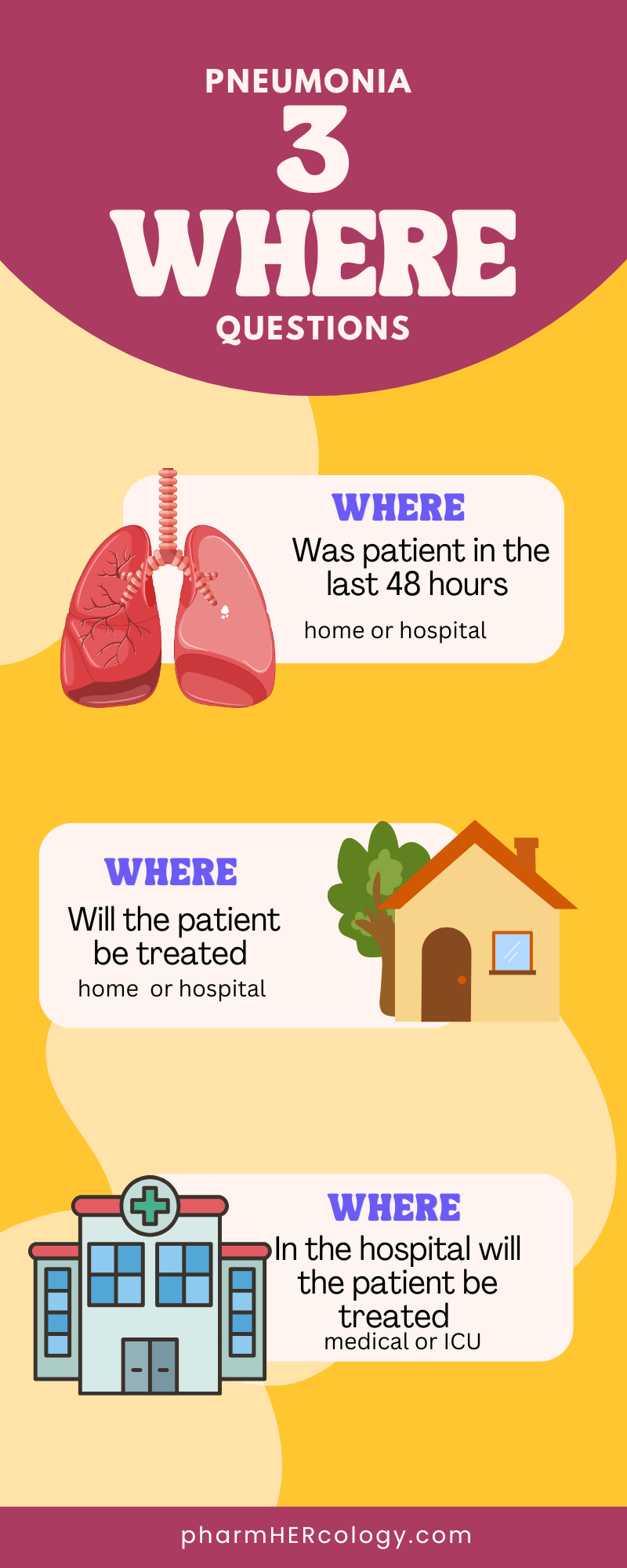
For patients who are critically ill, the risk of mortality is higher if they are first placed on the medical floor and then transferred to ICU. Assessing the need for a higher level of care is one of the 3 “where questions” in the treatment of pneumonia.
The severe CAP criteria is divided into major and minor criteria.
Major Criteria
The major criteria are straightforward. If you patient is hypotensive enough to require the use of vasopressors or requires mechanical ventilation due to respiratory failure, the recommendation is that your patient is admitted directly to intensive care.

Minor Criteria
If your patient does not clearly need ICU admission we assess the minor criteria. If there are 3 or more minor criteria, this suggests that your patient is high risk for ICU admission.

The selection of appropriate antibiotics in patients admitted to the ICU for community acquired pneumonia is dependent on specific risk factors.

All patients must have a throughout assessment of their medical history to see if they have had:
- history of respiratory MRSA infection in the past 12 months
- history of pseudomonas infection in the past 12 months
- history of recent hospitalization in the past 3 months with use of IV antibiotics
If none of these are present then your patient is considered to have no significant medical history with regards to pneumonia.
These risk factors result in 5 clinical scenarios for your patients with community acquired pneumonia requiring intensive care.
Clinical Scenario 1:
Your patient has no history of MRSA or pseudomonas in the last year and no hospital admission with IV antibiotics in the last 90 days.

Fluoroquinolone monotherapy is not recommended for inpatient treatment of CAP.
Clinical Scenario 2:
Your patient has a history of respiratory MRSA in the last 12 months.

Clinical Scenario 3:
Your patient has a history of respiratory pseudomonas in the last 12 months.

Zosyn will provide the coverage of regimen 1 + pseudomonas coverage. This is the same regimen for a patient non-severe inpatient CAP (general medical)
Clinical Scenario 4:
Your patient has a history of respiratory MRSA and pseudomonas in the last 12 months

This is the same regimen for a patient non severe inpatient CAP (general medical) with history of MRSA and pseudomonas.
Clinical Scenario 5:
Your patient has a history of hospitalization with intravenous antibiotics in the last 90 days
- vancomycin + piperacillin-tazobactam
- Get sputum gram stain and culture
- Deescalate to standard regimen (clinical scenario1) is results return negative.
If you compare scenarios 5 in the ICU group and general medicine group we see that in the more critically ill patients we do not wait for culture results to expand coverage for multidrug resistant bacteria. In both cases we obtain cultures, ideally prior to any antibiotic treatment but wait on the results to broaden coverage in non-ICU patients.
It is a good idea to compare each of these 5 clinical scenarios for ICU patients to the corresponding scenarios for non ICU patients. It is more efficient to know one set of regimens and how it changes with a different level of care versus memorizing each as separate topics. You can find the regimens for non medical ICU patients here.
Alternative Antibiotics
When are they needed?

The primary regimen provided in each clinical scenario include antibiotics that are fairly common throughout the United States. A common reason you will have to deviate from this standard regimen is allergy.
Pneumonia guidelines are laced with beta lactams. Unfortunately penicillin is also the most commonly reported drug allergy. Whether these are true anaphylactic responses or simply drug intolerances/unfavorable side effects is another discussion in itself.
Some hospitals preferentially use antibiotics that have lower dosing frequencies or requires less management. Azithromycin, for example, is dosed daily, clarithromycin is dosed twice a day. Vancomycin requires patient specific dosing and fairly frequent monitoring of labs and levels. Linezolid does not.
Certain antibiotics may be restricted to use only by infectious disease doctors due to their cost and spectrum of coverage. Those antibiotics are usually referred to as the “big guns” and are reserved for especially resistant strains of bacteria like extended spectrum beta lactamase resistance or Acinetobacter.
Know what antibiotics are on your hospital’s formulary and which have restricted access.
Sputum Cultures:
When are they needed in CAP?
The ATS/IDSA guidelines state that they are “neither for or against routinely obtaining sputum gram stain and cultures in all adult patients treated in a hospital setting.”
They however specifically recommend sputum gram stain and cultures in severe CAP (ICU admission) and when there are risk factors for MRSA and pseudomonas (history for prior infection in the last 12 months or history intravenous antibiotics in the last 3 months).

If there is an actual documented history of MRSA and/or pseudomonas: start empiric antibiotic coverage and deescalate if the sputum results are negative.
If they have no history of respiratory MDR bacteria but are at risk for MRSA and/or pseudomonas due to exposure wait for culture results before extending coverage.
Gram stains usually result in 24 hours, culture results in 24-48 hours.
Blood Cultures:
When are they needed in CAP?
ATS/IDSA guidelines recommended that blood cultures be drawn PRIOR to initiation of antibiotics only in those same patients we just discussed for sputum cultures. Hospitalized patients with:
- severe CAP (ICU admission)
- history of respiratory MRSA and/or pseudomonas in the past 12 months
- recent exposure to MRSA and/or pseudomonas exposure i.e. hospitalization with intravenous antibiotics in the past 3 months
If we’re covering MRSA and/ or pseudomonas for treatment of CAP we need blood and sputum cultures.
Why do we need blood cultures for pneumonia?
Infectious organisms can enter the lower respiratory tract in 1 of 3 ways:
- direct inhalation
- aspiration from the throat (oropharyngeal)
- via the blood from another site of infection (hematogenous transfer)
Duration of Treatment
The ATS/IDSA guidelines are pretty straightforward with regard to the duration of treatment for CAP.
- Treatment should be no less than 5 days even if patient is clinically stable before then
- If CAP is due to MRSA or pseudomonas then treat for 7 days
IDSA provides a great overview of the clinical pathway for community acquired pneumonia that is a great supplement to what you’ve learned here.
Hopefully the way the guidelines have been deconstructed here will make it easier to apply in your practice. CAP is one of those disease states you will see over and over again. Use the aids and illustrations as a reference and soon it will become second nature.

Subscribe
Subscribe to get the latest study unit in your inbox.
The information on this website is intended to be used solely for educational and informational purposes. While the content may be about specific medical and health care issues, it is not a substitute for or replacement of personalized medical advice and is not intended to be used as the sole basis for making individualized medical or health-related decisions.
One thought on “Community Acquired Pneumonia: When to Admit to ICU and How to Treat”