

In the unit Respiratory Tract Infections: Pneumonia we covered the assessment of a patient presenting with signs and symptoms of pneumonia including differentiating between the 3 main types. In the unit Community Acquired Pneumonia: Outpatient Treatment we talked about those patients who are stable enough to be treated at home. This unit focuses on the treatment of patients with community acquired pneumonia who have a risk of morbidity or mortality great enough to warrant treatment in the hospital.
We can objectively assess where a patient with community acquired pneumonia should be treated based on the CURB 65 score.
CURB 65
The preferred way to asses whether hospital admission is required for pneumonia is the Pneumonia Severity Index (PSI). PSI estimates the mortality of adult patients with CAP. It is complicated to calculate. It requires alot of patient history and labs that are not readily available in the outpatient setting including pH and partial pressure of oxygen.
Instead the CURB 65 score is used to assess risk of mortality and therefore the level of care (inpatient, outpatient) in patients presenting with CAP.

CURB-65 assigns 1 point for each of the 4 assessment points.
The urea level is the blood urea nitrogen (BUN). Normal levels are 5-20mg/dL. Because it requires a lab draw, BUN is not always readily available in many outpatient settings. There is an abbreviated score called CRB-65 that eliminates the urea component.
Respiratory rate >30 breaths per minute is 1 point.
Blood pressure <90/60 mmHg is 1 point
Age > 65 is 1 point
A CURB-65 score of 2 or more s a high risk for morbidity and/or mortality therefore the need for hospital admission.
MedCalc offers a CURB 65 score calculator.
At this point we’ve answered 2 of the 3 “where” questions of pneumonia.
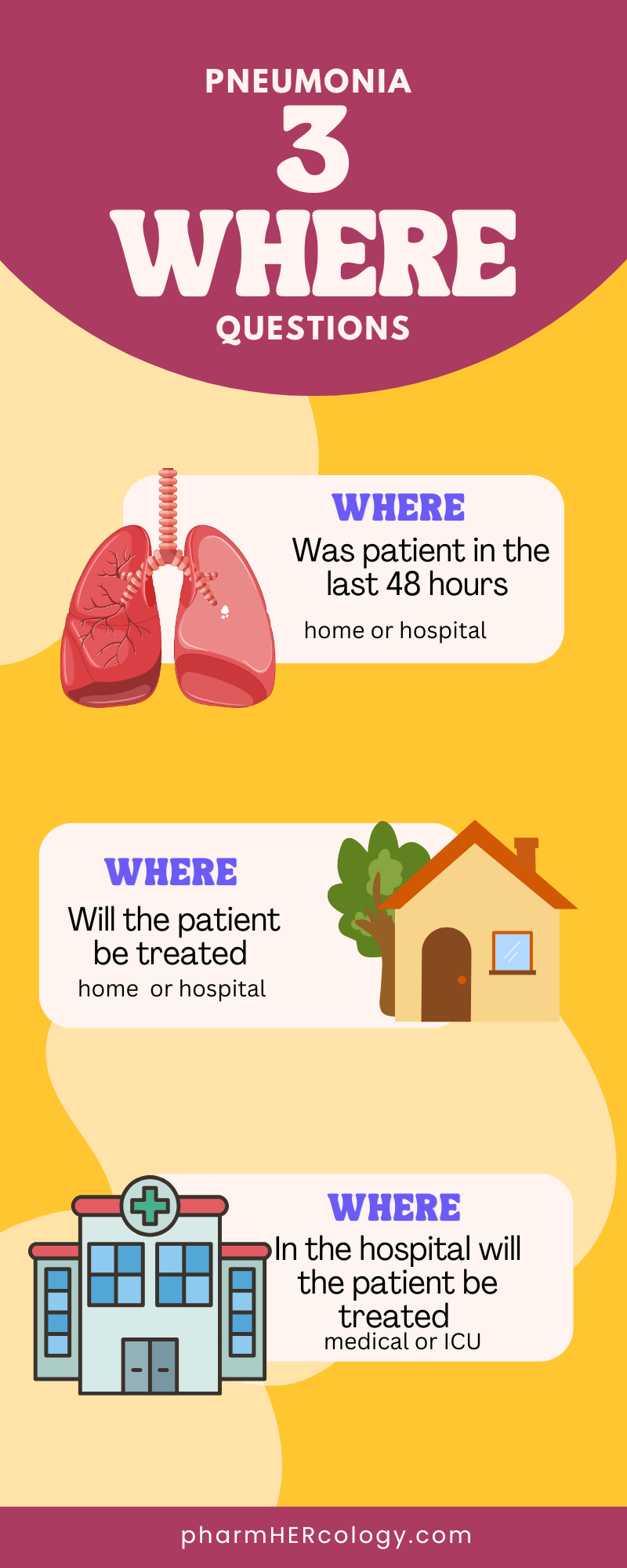
- Where the bug was contracted: community or within 48 hours of hospital admission
- Where the patient will be treated: hospital (inpatient, CRB>2)
At this point we need to decide another where. Where in the hospital will they be treated. Whether they go to ICU or general medicine floor requires assessment of the severe cap criteria.

Severe CAP Criteria
This is a clinical tool designed to predict the probability of ICU admission. It includes criteria that can be readily assessed in any emergency room. The CAP criteria is divided into 2 categories: major and minor.

The major criteria are straightforward. If you patient is hypotensive enough that they require the use of vasopressors or requires mechanical ventilation due to respiratory failure, the recommendation is that your patient is admitted directly to intensive care.
If your patient requires hospitalization (CURB/CRB>2) but does not require vasopressors or mechanical ventilation, we assess minor criteria.

The ATS/IDSA guidelines define severe community acquired pneumonia as either one major criteria or atleast 3 minor criteria. 3 or more minor criteria suggest the need for higher levels of care like ICU or telemetry. Everyone else can admitted to general medical floor if there are no confounding complications. Always use clinical judgement in conjunction with these prognostic tools to determine the level of care.
Just like the decision to treat inpatient versus outpatient, there are cost considerations and procedural risks associated with ICU stays. On the other hand, there is a higher rate of mortality when a patient is transferred from the floors to the units versus direct admission to the units.
Assess History of Infection
We now know where in the hospital our patient will be treated. Before we select antibiotics for inpatient treatment we have to assess their history of infection. Whether you’ve decided ICU or general medicine, all adults treated inpatient must be have they history checked for:

- history of respiratory MRSA in the last 12 months
- history of pseudomonas in the past 12 months
- history of hospitalization with IV antibiotics in the last 3 months
If your patient has none of these they are considered as having no significant history with regards to pneumonia.
These 4 criteria will determine what antibiotics will be used. Like we did for outpatient treatment of CAP we will look at clinical scenarios and treatments regimens for each sub category of inpatient CAP.
Refer to Respiratory Tract Infections: Pneumonia to review what bacteria we are targeting in each type of pneumonia.
Subscribe for Access to Exclusive Content
General Medical: Inpatient
Clinical Scenario 1:
Your patient has no history of MRSA or pseudomonas in the last year and no hospital admission with IV antibiotics in the last 90 days.

Clinical Scenario 2:
Your patient has a history of respiratory MRSA in the last 12 months.

Clinical Scenario 3:
Your patient has a history of respiratory pseudomonas in the last 12 months

These regimens above will provide the coverage of the regimen in scenario 1 + pseudomonas coverage.
Clinical Scenario 4:
Your patient has a history of respiratory MRSA and pseudomonas in the last 12 months

Clinical Scenario 5:
Your patient has a history of hospitalization with intravenous antibiotics in the last 90 days
- Use standard regimen (clinical scenario 1)
- Get sputum gram stain and culture
- Escalate to coverage for MRSA or pseudomonas based on culture/gram stain results
Clinical scenario 5 will gain more context as we move on to community acquired pneumonia patients who require higher levels of care than general medicine in the next unit.
Alternative Antibiotics
When are they needed?

The primary regimen provided in each clinical scenario include antibiotics that are fairly common throughout the United States. A common reason you will have to deviate from this standard regimen is allergy. Pneumonia guidelines are laced with beta lactams.
Unfortunately penicillin is also the most commonly reported drug allergy. Whether these are true anaphylactic responses or simply drug intolerances/unfavorable side effects is another discussion in itself.
Some hospitals preferentially use antibiotics that have lower dosing frequencies or requires less management. Azithromycin, for example, is dosed daily, clarithromycin is dosed twice a day. Vancomycin requires patient specific dosing and fairly frequent monitoring of labs and levels. Linezolid does not.
Certain antibiotics may be restricted to use only by infectious disease doctors due to their cost and spectrum of coverage. Those antibiotics are usually referred to as the “big guns” and are reserved for especially resistant strains of bacteria like extended spectrum beta lactamase resistance or Acinetobacter.
Know what antibiotics are on your hospitals formulary and which have restricted access. Be familiar with the alternative antibiotics listed below the primary regimen. It is useful to know what antibiotic you would recommend in the event of a penicillin allergy.
Sputum Cultures:
When are they needed in CAP?
The ATS/IDSA state that they are “neither for or against routinely obtain sputum gram stain and cultures in all adult patients treated in a hospital setting.”
They however specifically recommend sputum gram stain and cultures in severe CAP (ICU admission) and when there are risk factors for MRSA and pseudomonas (history for prior infection in the last 12 months or history intravenous antibiotics in the last 3 months).
If there is an actual documented history of MRSA and/or pseudomonas: start empiric antibiotic coverage and deescalate if the sputum results are negative.
If they have no history of respiratory MDR bacteria but are at risk for MRSA and/or pseudomonas due to exposure then wait for culture results before extending coverage.
Gram stains usually result in 24 hours, culture results in 24-48 hours.
Blood Cultures:
When are they needed in CAP?
ATS/IDSA guidelines recommended that blood cultures be drawn PRIOR to initiation of antibiotics only in those same patient we just discussed for sputum cultures. These are Hospitalized patients with:
- severe CAP (ICU admission)
- history of respiratory MRSA and/or pseudomonas in the past 12 months
- recent exposure to MRSA and/or pseudomonas exposure i.e. hospitalization with intravenous antibiotics in the past 3 months
If we’re covering MRSA and/ or pseudomonas for treatment of CAP we need blood and sputum cultures.
Duration of Treatment
The ATS/IDSA guidelines are pretty straightforward with regard to the duration of treatment for community acquired pneumonia.
- Treatment should be no less than 5 days even if patient is clinically stable before then
- If CAP is due to MRSA or pseudomonas then treat for 7 days
This study unit is a hefty one. Hopefully the way the guidelines have been deconstructed here will make it easier to apply in your practice. CAP is one of those disease states you will see over and over again. Use the aids and illustrations as a reference and soon it will become second nature.

Subscribe
Subscribe to get the latest study unit in your inbox.
The information on this website is intended to be used solely for educational and informational purposes. While the content may be about specific medical and health care issues, it is not a substitute for or replacement of personalized medical advice and is not intended to be used as the sole basis for making individualized medical or health-related decisions.
3 thoughts on “Community Acquired Pneumonia: When to Admit and How to Treat”